
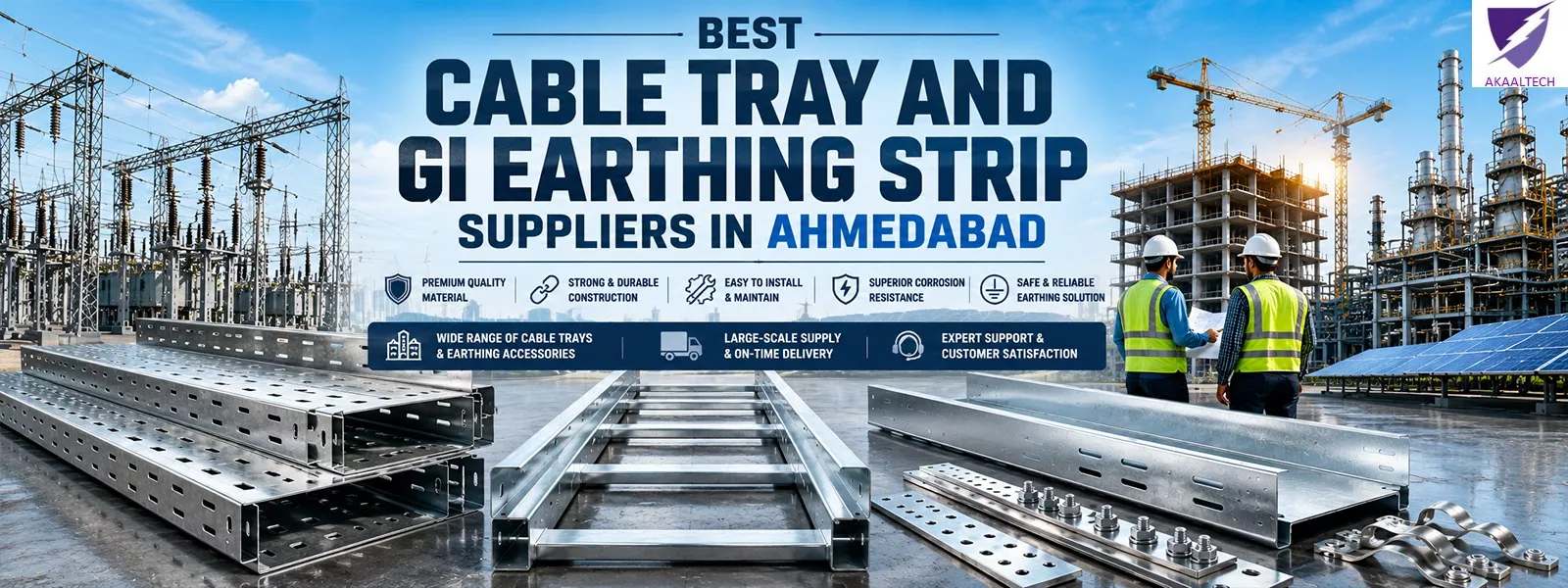
When it comes to electrical infrastructure, two things matter above all - reliable cable management and a proper earthing system. Whether you are building a factory, setting up a data centre, or wiring a large commercial complex, the quality of your cable trays and earthing components directly affects safety, performance, and long-term maintenance costs.
Ahmedabad is one of India's leading industrial cities, and the demand for quality electrical products here is growing fast. Contractors, consultants, and procurement teams are actively looking for a dependable cable tray manufacturer in Ahmedabad who can supply the right products on time and at competitive prices.
Akaaltech is a manufacturer and supplier of cable trays, GI earthing strips, earthing plates, lightning arresters, and related electrical safety products. This blog covers everything you need to know about these products - from technical specifications to buying tips - so you can make informed decisions for your next project.
Understanding Cable Trays and Earthing Systems
Cable trays are support structures used to carry and route electrical cables in buildings and industrial facilities. They keep cables organised, accessible, and protected from physical damage. Unlike conduit pipes, cable trays allow easy installation, inspection, and future additions to the cable layout.
Earthing systems, on the other hand, provide a safe path for fault currents to flow into the ground. A properly designed earthing system protects equipment, prevents electrical shocks, and ensures compliance with safety standards. GI (galvanised iron) earthing strips and copper strips are two of the most widely used conductors in grounding networks.
Together, cable management and earthing form the backbone of any electrical installation. Skimping on either can lead to costly failures and safety hazards down the line.
Types and Variants Available from Akaaltech
Akaaltech manufactures and supplies a wide range of products suited to different project requirements:
Cable Trays
Standard cable trays are available in ladder, solid-bottom, and channel configurations. They are made from mild steel, stainless steel, or aluminium, depending on the environment.
Perforated Cable Trays
Perforated cable trays feature evenly spaced holes across the tray surface. The perforations allow better air circulation around cables, reduce heat build-up, and make cable tie-down easier. Akaaltech is a well-known perforated cable tray manufacturer in Ahmedabad, supplying these trays in various widths and load ratings.
GI Earthing Strips
Hot-dip galvanised GI earthing strips are used to form earthing networks in substations, switchrooms, and industrial plants. As a reliable GI earthing strips supplier in Ahmedabad, Akaaltech offers strips in flat bar profiles with standard and custom dimensions.
GI and Copper Earthing Plates
Earthing plates are buried in the soil to provide a large surface area for current dissipation. GI earthing plates are suitable for general use, while copper earthing plates are preferred where lower resistance and longer service life are required.
Copper Earthing Strips
Copper strips offer high conductivity and excellent corrosion resistance. They are used in critical installations such as hospitals, data centres, and high-voltage substations.
Galvanised Earthing Strips and Earthing Flats
Available in standard sizes, these strips connect earthing electrodes, equipment frames, and busbars. They are easy to cut and bend on-site, making installation straightforward.
Chemical Earthing Electrodes
For sites with rocky or high-resistivity soil, chemical earthing electrodes provide a reliable low-resistance earth without deep excavation. They use a backfill compound to improve conductivity around the electrode.
Lightning Arresters
Lightning arresters protect structures and equipment from direct lightning strikes and surge voltages. Akaaltech supplies conventional and early-streamer emission (ESE) type lightning protection systems based on project requirements.
Key Features and Benefits
Choosing the right products from a quality manufacturer brings several advantages:
- Corrosion Resistance: Hot-dip galvanising on GI products and bare copper on copper products both provide long-term protection against rust and oxidation, even in humid or coastal environments.
- High Electrical Conductivity: Low-resistance materials ensure fault currents and lightning surge currents are efficiently dissipated to ground.
- Mechanical Durability: Steel cable trays can support heavy cable loads without deformation. Thick-gauge earthing strips maintain their shape during and after installation.
- Load-Bearing Capacity: Perforated cable trays are tested for specific load ratings. Selecting the correct rated tray prevents sagging over long spans.
- Improved Safety: A well-installed earthing system reduces the risk of electrical shock to workers and damage to connected equipment during fault conditions.
- Long Service Life: Quality-coated or copper products typically last 20-30 years with minimal maintenance.
- Low Maintenance: Once installed correctly, cable trays and earthing strips require only periodic inspections rather than frequent replacement.
Industries That Use These Products
The demand for cable trays and earthing products spans a wide range of sectors. Here is where these products are most commonly used:
- Power Plants and Substations: Large quantities of power cables need organised routing. Earthing systems must handle high fault currents safely.
- Manufacturing Facilities: Factories have extensive cabling for machinery, control panels, and lighting. Cable trays keep these runs neat and accessible.
- Commercial Buildings: High-rise offices and shopping centres use cable trays extensively in electrical rooms, false ceilings, and risers.
- Data Centres: Copper earthing strips and perforated trays are widely used in data centres where cable management and grounding integrity are critical.
- Telecom Projects: Tower installations and telecom shelters need robust earthing to protect sensitive equipment from surges.
- Infrastructure and Government Projects: Airports, metro rail projects, and highway toll plazas all require compliant earthing and cable management systems.
- Warehouses and Logistics Hubs: Large open-span warehouses use cable trays to run power and data cables along the roof structure.
- Hospitals and Healthcare Facilities: Electrical safety standards for hospitals are stringent. Copper earthing and proper cable routing are non-negotiable requirements.
- Educational Institutions: Schools and universities use cable trays in labs, auditoriums, and IT rooms where cable density is high.
How to Choose the Right Product?
Selecting the correct cable tray or earthing product for your project is not just about price. Here are the key factors to evaluate:
- Material Selection: For general indoor use, hot-dip galvanised GI is cost-effective. For outdoor or chemically aggressive environments, consider stainless steel trays or copper earthing strips.
- Thickness and Load Rating: Cable trays come in 1.2 mm, 1.6 mm, and 2.0 mm thickness. Calculate your cable load per metre and choose accordingly.
- Coating Quality: Check the zinc coating thickness on GI products. IS 2633 specifies a minimum of 610 g/m² for hot-dip galvanised steel.
- Standards Compliance: Ensure products meet IS 9537 for cable trays and IS 3043 for earthing. For export or international projects, look for IEC 61537 compliance.
- Installation Environment: Outdoor installations, underground burial, or chemical plant environments each require different product grades. Confirm the suitability before ordering.
- Project Quantity and Customisation: For large projects, check whether the supplier can offer custom dimensions, special bends, or accessories like covers, tees, and reducers.
Why Quality Matters in Electrical Safety?
In electrical infrastructure, poor-quality components are not just an inconvenience - they are a genuine hazard. Here is what can go wrong when quality is compromised:
- Electrical Faults and Fire Risk: A cable tray with inadequate load capacity can sag or collapse, damaging cable insulation. Damaged insulation can cause short circuits and, in worst cases, electrical fires. In 2023, a warehouse fire in Surat was attributed to overheated cable runs in improperly rated trays, according to fire safety reports.
- Poor Grounding Efficiency: If an earthing strip has high resistance due to substandard material or poor installation, fault current may not flow to ground quickly enough. This raises the touch voltage on equipment frames - a serious shock hazard for workers.
- Equipment Damage: Voltage surges caused by lightning or switching transients can destroy sensitive electronics if the earthing system cannot handle the surge. A proper lightning arrester combined with a low-impedance earthing network significantly reduces this risk.
- Regulatory Non-Compliance: Projects that do not meet IS 3043 or IEC 62305 standards can fail inspections, delaying commissioning and attracting penalties. Using certified products from a recognised manufacturer simplifies compliance documentation.
Why Businesses Prefer Reliable Manufacturers and Suppliers in Ahmedabad?
Ahmedabad has a strong base of electrical component manufacturers, but not all suppliers offer the same level of product quality, service, and technical support. Here is why procurement teams repeatedly choose established local manufacturers like Akaaltech:
- Consistent Product Quality: In-house manufacturing allows tighter control over raw material grades, coating thickness, and dimensional tolerances. This matters when you are sourcing a perforated cable tray supplier in Ahmedabad for multiple project batches.
- Manufacturing to Standards: Products manufactured against BIS and IEC benchmarks reduce the risk of specification mismatches on regulated projects.
- Timely Delivery: Local manufacturers reduce transit times for Gujarat-based projects. Ready stock for standard sizes means faster project execution.
- Customisation Capability: Non-standard cable tray widths, custom GI earthing strip cross-sections, and special coatings can be arranged without long lead times.
- Technical Support: A manufacturer who understands the product can assist with material selection, layout advice, and compliance queries - something a trading-only supplier may not provide.
- Bulk Supply Capability: Large infrastructure and industrial projects require consistent bulk quantities. A cable tray supplier in Ahmedabad with its own manufacturing unit can better manage large order volumes without quality variations.
Conclusion
Cable trays and earthing products are not just supporting components - they are fundamental to the safety, reliability, and longevity of every electrical installation. Whether you need a perforated cable tray for a data centre, GI earthing strips for an industrial plant, or copper earthing plates for a hospital, choosing the right product from a trusted source matters.
Working with an experienced cable tray manufacturer in Ahmedabad like Akaaltech means you get products that meet standards, arrive on time, and are backed by technical knowledge. From small commercial projects to large infrastructure contracts, having a reliable manufacturer and supplier in your procurement chain reduces risk and simplifies compliance.
For product enquiries, bulk quotes, or technical specifications, get in touch with Akaaltech today.
Frequently Asked Questions
1. What is a perforated cable tray and why is it used?
A perforated cable tray has holes punched across the tray floor and sides. These holes help with cable ventilation, reducing heat accumulation for high-density cable runs. They also allow easier cable tie-down and water drainage in outdoor applications. As a perforated cable tray supplier in Ahmedabad, Akaaltech manufactures these in widths from 100 mm to 600 mm.
2. Why are GI earthing strips preferred over copper in some projects?
GI earthing strips are significantly more economical than copper. For projects where budget is a constraint and soil corrosivity is not extreme, hot-dip galvanised GI strips perform well within their expected service life. They are widely specified in industrial plants and commercial buildings.
3. How do copper earthing plates improve grounding performance?
Copper has much lower electrical resistance than steel. Copper earthing plates provide a larger surface area in contact with soil, which reduces earth resistance and improves fault current dissipation. They are particularly effective in high-value installations like hospitals and IT facilities where low earth resistance is specified.
4. What is the difference between a GI earthing strip and a galvanised earthing strip?
The terms are often used interchangeably. GI (galvanised iron) earthing strips are flat steel bars coated with zinc through hot-dip galvanising. The zinc layer prevents corrosion. 'Galvanised earthing strip' simply refers to the same type of strip with a zinc coating applied by galvanising.
5. What industries require lightning arresters?
Lightning arresters are required in any facility exposed to lightning risk - particularly telecom towers, power substations, rooftop equipment installations, chemical plants, petrol stations, hospitals, and large commercial buildings. IEC 62305 provides the international standard for lightning protection system design.
6. How do I choose the correct cable tray width and depth?
Calculate the total cross-sectional area of all cables to be installed in the tray. Add a 30-40% space factor for future additions and heat dissipation. Choose tray depth based on the maximum cable diameter. Consulting the cable manufacturer's datasheet and IS 9537 gives you the most accurate sizing.
7. What standards apply to cable trays manufactured in India?
The primary Indian standard for cable trays is IS 9537 (Parts 1-5), which covers material, construction, and testing requirements. For international projects, IEC 61537 is the applicable standard. Products tested to these standards are more likely to meet project specification requirements.
8. Can earthing strips be customised to project specifications?
Yes. Akaaltech can supply GI and copper earthing strips in custom widths and thicknesses. Common standard sizes are 25x3 mm, 25x6 mm, 32x6 mm, and 40x6 mm, but other cross-sections can be produced for specific load requirements.
9. What is chemical earthing and when is it used?
Chemical earthing uses a pre-filled electrode with a conductive backfill compound to create a low-resistance earth in rocky or sandy soils where a conventional plate or pipe electrode would not achieve the required resistance. It is commonly used in dry, hard-rocky terrain, or where excavation depth is limited.
10. What is the typical earth resistance value required for installations?
IS 3043 specifies that earth resistance should not exceed 1 ohm for power system earthing and can be up to 5 ohms for smaller installations, depending on the application. Data centres and hospitals often specify values below 1 ohm. The actual target value is defined by the project specification and the consulting engineer.
