
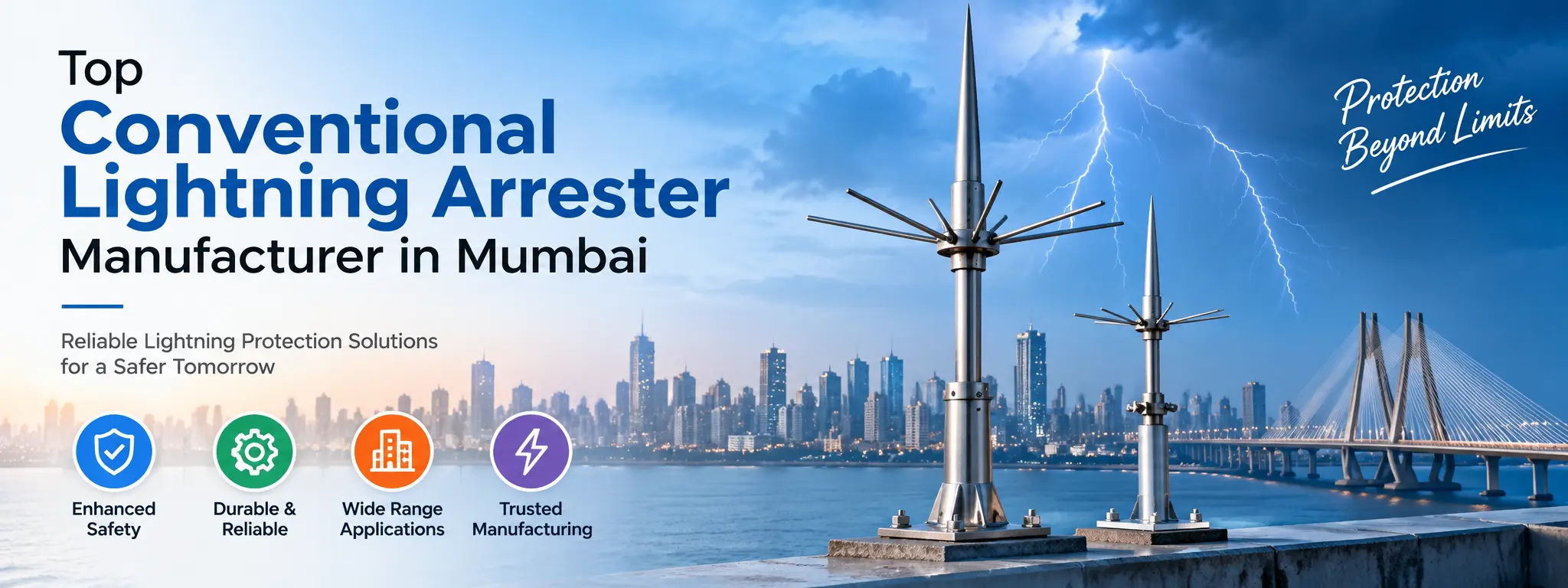
Mumbai gets some of the highest lightning strike density in western India, especially during the June to September monsoon. High-rise terraces near Powai, Thane creek and the eastern suburbs take repeated hits every season. Salt-laden coastal air also corrodes air terminals faster than inland cities. This is why finding a proper Conventional lightning arrester manufacturer in Mumbai matters more than picking the cheapest rod on a quotation sheet. Akaaltech, manufacturing earthing and lightning protection systems since 2012, is one brand that has built its product line specifically around these checkpoints. Here is what to check before you shortlist anyone, including us.
What Is a Lightning Arrester System Made Of for Mumbai Buildings?
A conventional lightning arrester is not one single product. It is three parts working together.
- Air terminal (the rod) - the vertical strike point, usually copper or copper-bonded
- Down conductor - the tape or cable carrying current to ground, typically 25mm x 6mm copper tape
- Earth termination - the pit and electrode system that discharges the current safely
Buyers understand a lightning arrester faster when its listing separates these three parts clearly instead of bundling them as one "kit". If a manufacturer's page does not break the product down this way, ask them to.
Lightning Arrester Rod Specifications for Mumbai: What Separates a Good One From a Cheap One?
The rod itself looks simple in a photo. That simplicity is exactly where buyers get fooled on a lightning arrester purchase.
Cheap rods use thin-walled tubing. A genuine lightning arrester rod has a solid or thick-walled copper or copper-bonded core, usually 12.5mm to 16mm in diameter, built to survive repeated strikes without pitting.
On terraces near the creek we usually see rods that have gone dull and flaky within two monsoons. That is a material spec problem, not a design flaw.
Ask for the wall thickness and base material in writing, as a spec sheet for the lightning arrester, not a verbal claim.
Lightning Arrester Certification in Mumbai: IS 2309 and IEC 62305 Checkpoints
Any brand worth shortlisting should build its lightning arrester line to IS 2309 for air termination and earthing, and reference IEC 62305 for risk classification. These are not stickers. They define real, checkable numbers per component.
Check three lightning arrester figures on the datasheet:
- Conductor cross-section (25mm x 6mm copper tape is standard)
- Rod strike current withstand rating
- Earth resistance target, usually under 5 ohm for a standard structure, under 1 ohm for sensitive installations
If a brand's lightning arrester literature skips these numbers, the product was likely never independently tested.
Lightning Arrester Material Options in Mumbai: Pure Copper vs Copper-Bonded vs GI in Coastal Air
This is the lightning arrester material decision that costs buyers the most money later, so it deserves a proper table.
| Material | Corrosion Resistance in Coastal Air | Typical Cost | Best Suited Lightning Arrester Use |
|---|---|---|---|
| Pure Copper | Excellent | High | High-rises, coastal facilities, refineries |
| Copper-Bonded Steel | Good, if plating is even | Medium | Mid-rise residential and commercial |
| GI (Galvanised Iron) | Weak within 3-5 years near sea | Low | Inland, low-budget temporary structures |
Pure copper rods perform best but cost more upfront. Copper-bonded is a reasonable middle-tier choice if the bonding layer is applied evenly, without thin patches.
GI rods appear often in bulk quotations because they are cheap. In Mumbai's humidity and salt exposure, this is usually a false economy.
Why Akaaltech Is Among the Top Lightning Arrester Manufacturers in Mumbai?
Akaaltech was founded in 2012 by Engineer Manmohan Singh, with a manufacturing facility and in-house R&D based in Faridabad. The company has completed over 1500 projects and works with more than 1200 clients across India, including sites in the Mumbai region.
A few things separate the brand on this specific product line:
- Conventional lightning protection systems manufactured to IS/IEC 62305, not just sold under that label
- In-house R&D, so rod specs and earthing components are engineered together, not sourced from unrelated vendors
- A product range that covers the full earthing and lightning protection system, from copper-bonded rods to earth enhancement compounds and exothermic welding
This full-system approach matters because a lightning arrester rod is only as good as the earthing it is connected to.
How to Read a Lightning Arrester Manufacturer's Test Certificate in Mumbai?
A test certificate for a lightning arrester is only useful if it names the exact product batch. Vague certificates are a common trick in this trade.
Look for the testing lab's NABL accreditation number, the exact standard referenced (IS 2309, not just "BIS approved"), and the test date. Certificates older than two to three years for the current batch are a red flag.
Ask the lightning arrester supplier for the batch-wise test report on the specific rod model you are buying, not a generic company certificate. This is where buyers get it wrong most often.
A serious brand will not mind this request. Akaaltech, for instance, shares batch-wise test reports on request, and it usually takes a day to get one.
Lightning Arrester Installation Factors That Decide Performance in Mumbai
Even a good lightning arrester rod fails if the earthing component is poor. This is the part contractors sometimes rush.
Earth pit depth, soil moisture and the number of parallel pits all affect the final resistance reading. In Mumbai's rocky patches around Ghatkopar and parts of the western suburbs, a single pit rarely gets you under 5 ohm.
We usually recommend testing resistance after the first monsoon, not only at commissioning. Soil conditions shift, and so does the reading.
A lightning arrester brand's rod quality only shows fully when the down conductor run is short, properly clamped, and free of sharp bends. Sharp bends raise resistance and strike risk at the bend point.
Conventional Lightning Arrester Manufacturer in Mumbai: How to Shortlist One?
Once you understand material and certification needs, comparing lightning arrester manufacturers active in the Mumbai region comes down to five checks.
Quick shortlist checklist for a lightning arrester
- Ask for three recent project references in Mumbai, ideally coastal or high-rise sites
- Request batch-specific test certificates for the exact rod model
- Confirm wall thickness and base material in writing
- Check if they also offer earth pit installation and maintenance services, since poor earthing undoes a good lightning arrester
- Compare warranty terms on the lightning arrester, not just the upfront price
Most buyers stop at price comparison. That is the fastest way to end up replacing a lightning arrester in three years instead of fifteen.
If the vendor also handles earth resistance testing and periodic maintenance, that usually indicates they understand the full lightning arrester system, not just the rod.
Frequently Asked Questions
1. How long does a copper-bonded lightning arrester rod typically last in Mumbai's coastal humidity?
A well-bonded copper rod usually lasts 10 to 15 years near the coast if the plating has no thin patches. Poorly bonded rods can show pitting within 3 to 4 years, especially near the creek or sea.
2. Do lightning arrester installations in Mumbai need BMC or fire NOC approval?
Most standalone lightning arrester installations do not need a separate BMC clearance, but high-rises above a certain height usually need the system reflected in the fire NOC drawings. Check with your structural consultant before finalising the design.
3.Which lightning arrester rod material should a manufacturer recommend for coastal Mumbai sites?
For sites facing direct salt spray, a manufacturer should recommend pure copper or a well-bonded copper-bonded rod over GI. A standard GI rod in these zones usually needs replacement within 3 to 4 years, while copper-based rods last 10 to 15.
4. Is a lightning arrester compulsory for high-rise buildings in Mumbai under current fire safety norms?
Yes, Maharashtra fire safety norms require lightning protection systems for buildings above a specified height, usually 30 metres and above. Your architect or fire consultant can confirm the exact threshold for your building category.
Conclusion
Choosing a Conventional lightning arrester manufacturer in Mumbai comes down to material, certification and how honestly a supplier answers your questions about each component. Price should be the last filter, not the first. Akaaltech has built its conventional lightning protection line around exactly these checkpoints since 2012, with in-house R&D and over 1500 completed projects. Compare two or three shortlisted suppliers on these points before you commit.
If you are evaluating options for your building or site, get in touch with Akaaltech for the spec sheet and test certificates on our conventional lightning arrester range — no pressure to buy, just the numbers to compare against.
